
The balance between economic success, environmental protection and social responsibility has been an integral part of the corporate culture at Richard Pieris and Company PLC for decades, as we endeavour to achieve more with less. We have continuously made our business viable by integrating sustainability into the heart of the enterprise, where our efforts have created value for our stakeholders as the challenges we face go far beyond financial statements. As a responsible business entity, we are cognisant that we have an obligation to fulfil towards the society we operate in, since our sustenance is derived from the multiple facets of society. We are continuously working to create sustainable value for all our stakeholders and to support communities, while minimising environmental impacts.
We aim to pioneer new solutions for sustainable development while continuing to shape our business responsibly and increasing our economic success. Our Group boasts of a proud history of responsible business practices and strong principles of quality, value and integrity, which lie at the heart of our business strategy. The Group is one of the largest and oldest diversified conglomerates in Sri Lanka with a vast number of stakeholders. We engage in numerous economic, social, and environmental support initiatives targeted at fulfilling our responsibilities to all stakeholders. We aspire to grow beyond boundaries and have achieved many a milestone through diversification, yet our commitment to corporate social responsibility has not been compromised. We have continuously developed and strengthened our sustainability outlook year-on year, having learnt that it opens a world of new opportunities for both the Group and our stakeholders. Thus, we aim to engage positively with all stakeholders, responding to them swiftly and efficiently while continuing to welcome their views.
Our Customers
Every day, thousands of customers around the country consume or use our products and services. We have always strived to search for fresh ideas to serve our vast customer base and built lasting relationships with them, which has become our business model. For our customers, providing fresh and quality products through our retail chain has become customary and our focus is also vested in extending convenience to our customers.
Many of our products enable the usage of fewer resources, such as energy and water, bio gas and reduced energy consumption. Working with suppliers, governments, businesses and other partners enables us to find new ways to innovate and have a positive influence beyond our operations and products.
Some of our companies have integrated with their customers and mutually plan productions and delivery schedules to achieve operational excellence.
Understanding customer needs and responding to them is part and parcel of our business model. We have continuously used various methods to reach out to customers, whilst our physical presence through state-of-the art outlets and island-wide distributor networks has supported our theme, “Touching Lives”. We are in the journey of transforming from traditional energy consumption to solar power, with our outlets being converted or built with solar panels, thus reducing our carbon footprint. Our Retail chain holds the ‘Platinum Class Green Retail Building’ certification in Sri Lanka. Our retail chain has introduced many promotional activities throughout the year which have added value to the end customer with exciting gifts and rewards. The Retail chain introduced its own dedicated Electric Car taxi service exclusively for shoppers’ convenience, a value added service that Arpico was first to offer the Sri Lankan market. We have established a number of alliances with some financial institutions to enable access to our customers for smart buying options, etc. Our customer relationship management spans across a number of facets including customer suggestions, satisfaction measurement and data base management, which are continuously evaluated to serve our customers in a timely manner.
Our Food Safety
As a leading Retail chain in Sri Lanka, food safety is one of our key priorities. We have consistently surpassed our competitors in providing the best products to customers. We maintain stringent policies on food safety and quality, and state-of-the-art cooling chains are in place to ensure the best quality of the products at any given time. The increase in the number of customers who pass through our doors daily is testimony to the trust they have placed on our commitment towards the food safety.
- Good Agricultural Practices (GAPs)
Agricultural practices adopted on estates conform to TRI (Tea Research Institute) guidelines/regulations and internationally certified standards such as Rain Forest Alliance, Ethical Tea Partnership and FLO.
- Good Manufacturing Practices (GMPs)
From the time tea is harvested in the field until it is packed, GMPs are followed in our factories, conforming to internationally accepted standards such as HACCP/ISO 22000.
ISO 22000: 2005 System Certification – Food Safety Management System Certification for the below Tea Manufacturing Factories of the Company.
- Luckyland Estate
- Kirklees Estate
- Gampaha Estate
- Doteloya Estate
- Yataderiya Estate
Our Fair and Competitive Trading Practices
Our policy is to be fair and honest, accessible and forthright in our dealings and to always deliver what we promise. For this purpose, we ensure that all our relationships are based on trust and honesty, and we strive to deliver win-win solutions
Our Employees
Employee Health and Safety
The Richard Pieris Group is one of the largest private sector employers in the country, hence employees are considered as key stakeholders whose contribution is vital for the continued success of the Group.
The health and safety of our employees is a key priority, and much attention is placed in this regard at all factories and workplaces. Training programmes are consistently conducted to educate employees on health and safety measures at the workplace, while medical facilities are also provided to all employees. Our health and safety policies and standards incorporate the neccessary requirements and we aim to create a culture of safety through focus on the fundamental principles of leadership, competence and a safe working environment.
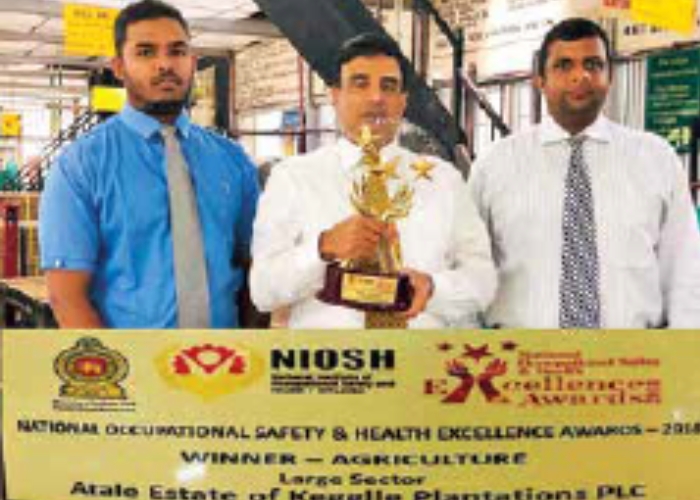
Safety is an integral part of our business framework. Our security function frequently reviews the safety levels at our locations and the results are reported to the management on a timely basis. Our total lost time accident rate is low and there were no major incidents during the year. Being a prudent employer, we have obtained necessary insurance covers to compensate losses. It is also noteworthy that Atale Estate of Kegalle Plantations secured the National Occupational Safety & Health Excellence Award at the ceremony held in 2020.
Community and Country
Our products are used daily by many households and we seek to encourage responsible product use through targeted communication. When it comes to implementing our sustainability strategy, it is our people who make the difference – through their dedication, skills and knowledge. They make their own contributions to sustainable development, both in their daily business lives and as members of society. They interface with our customers and consumers and drive innovation, develop successful strategies, and give Arpico its unique identity.
The Richard Pieris Group carries out a wide range of diverse activities across all provinces in Sri Lanka, with the objective of contributing towards the goodwill of the country. Our commitment for this purpose has enabled us to nurture a reputation of being a responsible corporate body. Our initiatives reach out across the island, from small isolated villages to urban centres, thereby touching the life of every Sri Lankan. The Group has always promoted a positive attitude towards age diversity, believing that a blend of youth and maturity will concurrently benefit both the company and the employees.
The Richard Pieris Group carries out a wide range of diverse activities across all provinces in Sri Lanka, with the objective of contributing towards the goodwill of the country. Our commitment for this purpose has enabled us to nurture a reputation of being a responsible corporate body. Our initiatives reach out across the island, from small isolated villages to urban centres, thereby touching the life of every Sri Lankan. The Group has always promoted a positive attitude towards age diversity, believing that a blend of youth and maturity will concurrently benefit both the company and the employees.
Our Suppliers
We develop innovative solutions and set standards for responsible sourcing together with our suppliers and partners. A thorough understanding of our supply chains has enabled us to promote sustainable relationships based on innovative and win-win solutions. We work closely with our suppliers to ensure that our company values are embedded throughout the supply chain system. We are also committed to improving the income opportunities of people who come into contact with our supply chains and our business, such as smallholders and various other suppliers.
Focused and efficient integration within the supply chain leads the Group to procure a range of products at high quality inputs at the best price, and this in turn converts to an integral component of its competitive advantage. Our dedicated supply chain team has continuously brought enormous cost benefits to the group by being a loyal customer to our vast network of suppliers that is spread across the world.
As a key part of our supplier strategy, we also aim to develop partnerships with small and medium-sized enterprises in the country and provide them with guidance in using new technology for manufacturing and tapping new markets. We have continuously supported local entrepreneurs and we desire to create opportunities for them in the domestic market through our numerous outlets across the island.
Our Initiatives
Vegetable Outgrower System
During the low cropping months, estate workers’ income could fluctuate resulting in a less income for the worker communities. Therefore, this vegetable outgrower project, being a brainchild of our Group Chairman, was commenced to provide an additional, steady income for the families of the estate workers during the low cropping periods. Accordingly, the worker families and the entire plantation community engages in growing vegetables in their home gardens. Further, several crops are being also trialed in plantations including Pears, Oranges, Avocado, Agarwood and Khaya under many different projects initiated within past few years. The efforts are expected to support the nation in terms of creating new employments and generating additional income.
Community Driven Waste Management Project and Child Nutrition
Quality of drinking water plays an important role in child and adult nutrition. Community driven waste management projects in some regions are conducted to prevent water sources getting contaminated by domestic waste. The project benefits at large where this project is also coupled with a child nutrition enhancing programme funded by Save the Children International.
Prevention / Mitigating of Honey Bee Attacks
There are plenty of incidents reported on Giant Honey Bee (GHB) (Apis dorsata) or commonly known “Bambara” attacks in plantations and several human deaths are caused due to this every year. However, there is a solution developed for this burning issue within Maskeliya Plantations by gathering knowledge on the behavior of Giant honey bees, also with an antidote developed for bee venom. Currently this knowledge is being spread within the plantations to prevent GHB attacks and avoid human deaths as a national responsibility.
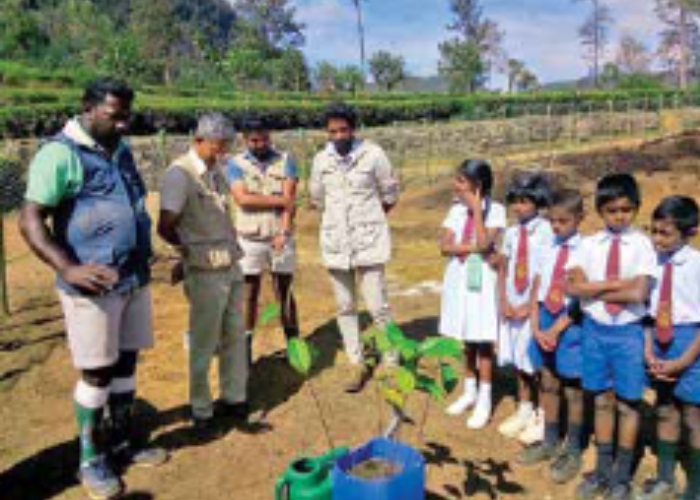
Community Tree Planting Programme
A community tree planting programme has been undertaken at some of our locations, at times with the help of the Department of Agriculture or with the assistance of any other plants received.
Upgrading of Plantation Operations with Skilled and Dignified Work Force
An initiative offering technical courses on proper operation and maintenance of tea farm machinery such as mechanical harvesters and pruning machines was launched, targeting school leavers and for benefit of the community at large. Trainees will be supported with a loan scheme to purchase their own machinery and also given job opportunities within the estates to earn a livelihood. This initiative was conceptualized to attract the young generation back to the plantations for what they perceive as more skilled jobs. This concept was themed, ’ Wedata Enna-Hedata Inna’ meaning ’Come and Work and be Smart’.
Mechanized Harvesting for Female pluckers
Female pluckers have been trained to undertake harvesting of Tea using motorized machines, an innovative concept which was introduced at Talawakelle estate of Maskeliya Plantations. As a result, crop yield has increased by 30% and leaf damage has also been minimised to a great extent. This machine is a product of Maskeliya Plantations introduced through a research project in collaboration with the Department of Agriculture Engineering, Faculty of Agriculture and University of Peradeniya.
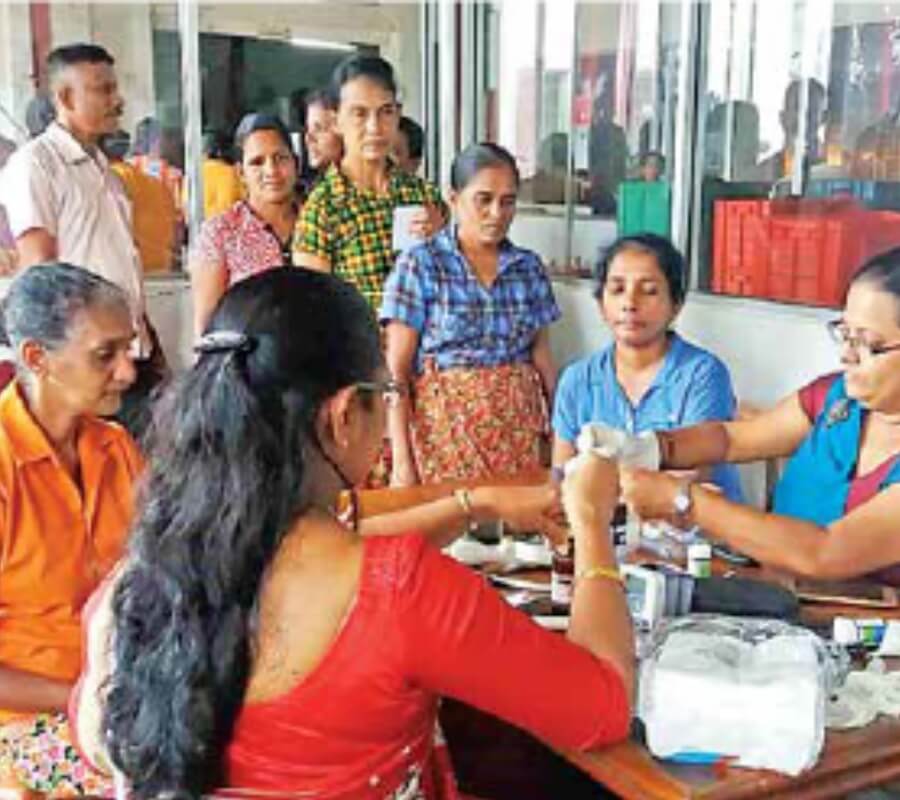
Supporting Health Care
At the plantations, free lunch is provided daily for children in the Child Development Centres and periodically for pensioners and pregnant women. The centres house the children of the Plantation workers and these facilities are offered free for the betterment of society at large. Several awareness programmes are held on health concerns of resident and non-resident estate persons on various topics, including an awareness programme for small holders on the consequences of using glyphosate in agricultural practices along with a Nutrition programme for children and parents who participated, including resident and non-resident families. The estate worker community is provided with healthcare and individual medical history records which are maintained in order to provide them with proper medical attention. In addition, Moray Estate introduced documentation on the history of pregnancies of all females of the estate (including non-workers), where each and every female with child/children has a record of their history of pregnancies. This record keeping has been well accepted and most appreciated by government hospitals, as individuals with a record of any previous abnormalities or problems can be attended to by hospital authorities .If the need arises, they could also be referred to other hospitals more equipped to handle such
situations, without undue delay.
Introduction of a Scholarship Scheme
All Estates have introduced a scholarship scheme for Grade five scholars as well as children entering universities where each selected student is provided with a monthly provision until completion of their university education. Grade five scholars are provided with a valuable stationery pack and teachers involved will be provided with gifts in appreciation of their service.
Child Development Centres
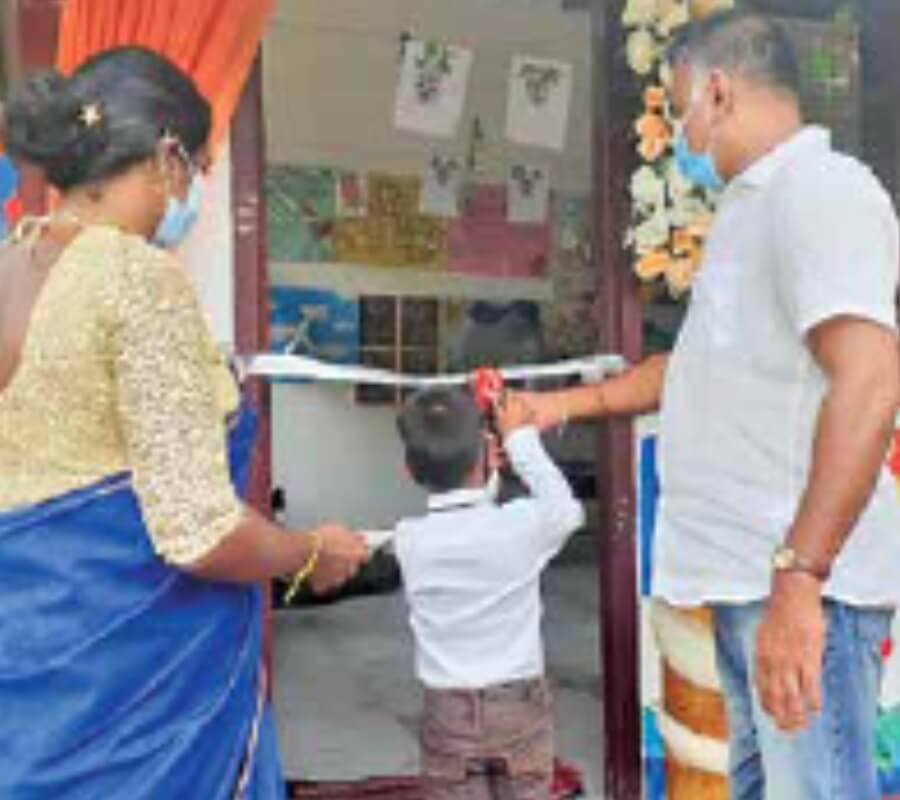
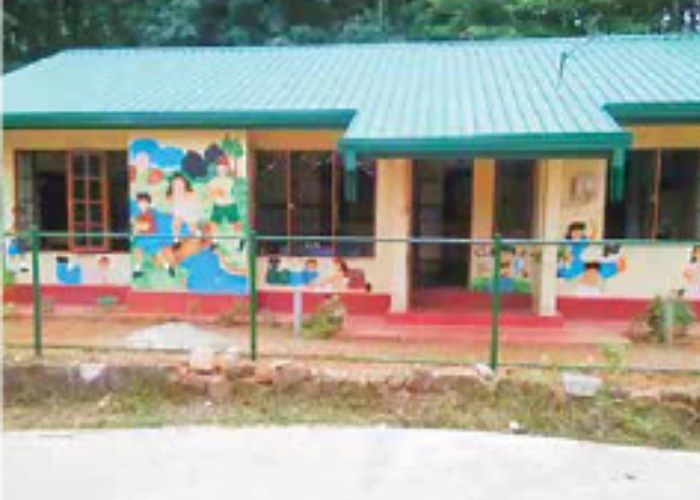
There are more than 100 Child Development Centres in the Plantations. Children attending these Child Development Centres are provided with a mid-day meal. This ensures a healthier future generation.
Maintenance of Worker Housing
Plantation workers are provided with free residential facilities, in particular at Maskeliya Plantations.
Our Commitment towards the Environment
Forest Conservation and Tree Planting
As a Company involved in Plantations, we have continuously encountered situations on normal land and forestry areas. Conservation of forestry areas as declared by the Central Environment Authority and the Government are clearly demarcated at the respective locations to ensure circumvention of encroachment. Areas in close proximity (60 metres) to waterways as catchment areas are included in conservation areas. Our approach to environmental preservation is not a one-time activity, but an ongoing journey towards maintaining a greener environment around us. Under this ongoing programme, we promote the habit of planting trees especially in our estates. Plants help to reduce temperature as a result of absorbing excess carbon dioxide. Having a green surrounding neutralises the effects of carbon dioxide emissions of our business activities. We have initiated pilot projects with fruits including pears, avocado, orange and mandarin etc, which will make the landscapes richer with diverse crops. The latest addition to this crop list is agar wood. Further, Maskeliya Plantations PLC has secured its biomass energy with giant bamboo, which will provide a steady supply of firewood for the processing centres. We are paving the way for cleaner environment and are also on the path to become carbon neutral or even to achieve carbon credits.
Nature and Diversity
Our estates spread over the wet zone covering Kegalle, Kalutara, Matara, Galle, Kurunagala, Nuwara Eliya and Badulla districts experience over 2500 mm of rain. Most of our Rubber estates in Kegalle, Kalutara and Galle districts are spread between the central highlands and western southern planes varying in elevations from 500 feet above sea level to 6,000 feet. The three plantation companies are situated in the wet zone, intermediate zone and are subdivided into low country, mid country and upcountry plantations. Most of the estates are close to natural forests or reservation lands for forestry where many endangered species of butterflies, birds and animals are provided protection.
Over a dozen different mini ecosystem types have been identified in Maskeliya, Udapussellawa, Haputhale, Nuwara Eliya and Nawalapitiya regions during a survey done on biodiversity. They range from pristine virgin forests and grasslands, to manmade ecosystems such as hydropower reservoirs, plantations and disturbed scrublands etc. Tea cover is the dominant vegetation type which conceals majority of the cultivable land area in Maskeliya. Our Group and the estate community take pride in the natural environment and we are committed to protect nature that we have been blessed with.
The manmade lakes of Maussakelle and Castlereigh hydropower schemes are cardinal aquatic ecosystems which regulate and transform the multi-purpose ecosystem services provided by nature, largely at national level including hydropower generation. Some of the other services are flood control, storage and gradual release of water catering to the requirements of people living downstream, including domestic water supply for Colombo and the suburbs. The local services offer scenery, inland fisheries and leisure, together with providing landing platforms for sea planes. Timber plantations and fuel wood plantations found in diversified marginal tea lands, due to soil degradation, also occupy a considerably large land extent. Scrublands are heavily infested with invasive exotic plant species, mostly introduced to the region. It is observed that most of the invasive plant species here are of Central American origin. Coster’s curse (Clidemia hirta) or “Kata Kalu Bovitiya” in local terms, is the most aggressive tea weed in Sri Lanka .“Gal Goraka” (Clusia rosea), “Kurunjan Pullu” (Austroeupatorium inulifolium) and “Maalu Othana Kola” (Micornia calvesens) are a few other examples to this effect.
Home gardens of the resident plantation worker community and commercial vegetable plots too collectively occupy an important part of estate land. The rest of the extent is shared by riverine forests seen along water causeways, rocky outcrops, marshy lands (Wet Patna) and isolated secondary forest patches scattered throughout the landscape. The Westward section of the region borders the Peak Wilderness Nature Reserve (PWNR), one of the most diverse primary forests in Sri Lanka and home to a vast number of endemic biological species. This pristine virgin forest is the core reservoir home for almost all the wildlife species found in the Maskeliya area. Hence, many of these species have crossed over and wandered into tea estate land, giving visitors the opportunity of admiring them at the estates, without entering into the nature reserve.
Over a dozen different mini ecosystem types have been identified in Maskeliya, Udapussellawa, Haputhale, Nuwara Eliya and Nawalapitiya regions during a survey done on biodiversity. They range from pristine virgin forests and grasslands, to manmade ecosystems such as hydropower reservoirs, plantations and disturbed scrublands etc. Tea cover is the dominant vegetation type which conceals majority of the cultivable land area in Maskeliya. Our Group and the estate community take pride in the natural environment and we are committed to protect nature that we have been blessed with.
The manmade lakes of Maussakelle and Castlereigh hydropower schemes are cardinal aquatic ecosystems which regulate and transform the multi-purpose ecosystem services provided by nature, largely at national level including hydropower generation. Some of the other services are flood control, storage and gradual release of water catering to the requirements of people living downstream, including domestic water supply for Colombo and the suburbs. The local services offer scenery, inland fisheries and leisure, together with providing landing platforms for sea planes. Timber plantations and fuel wood plantations found in diversified marginal tea lands, due to soil degradation, also occupy a considerably large land extent. Scrublands are heavily infested with invasive exotic plant species, mostly introduced to the region. It is observed that most of the invasive plant species here are of Central American origin. Coster’s curse (Clidemia hirta) or “Kata Kalu Bovitiya” in local terms, is the most aggressive tea weed in Sri Lanka .“Gal Goraka” (Clusia rosea), “Kurunjan Pullu” (Austroeupatorium inulifolium) and “Maalu Othana Kola” (Micornia calvesens) are a few other examples to this effect.
Home gardens of the resident plantation worker community and commercial vegetable plots too collectively occupy an important part of estate land. The rest of the extent is shared by riverine forests seen along water causeways, rocky outcrops, marshy lands (Wet Patna) and isolated secondary forest patches scattered throughout the landscape. The Westward section of the region borders the Peak Wilderness Nature Reserve (PWNR), one of the most diverse primary forests in Sri Lanka and home to a vast number of endemic biological species. This pristine virgin forest is the core reservoir home for almost all the wildlife species found in the Maskeliya area. Hence, many of these species have crossed over and wandered into tea estate land, giving visitors the opportunity of admiring them at the estates, without entering into the nature reserve.
Hydro Power
Hydro power plants at Talawakelle and Brunswick estates generate electricity which helps to supply for domestic use and also to contribute to the national grid.
Land Management
As a Group which holds Plantation Companies, we are always concerned about our environment, particularly soil. To safeguard against land and soil erosion, we continuously emphasis on improved land management structures and methods such as terracing, mulching, weeding, growing Manaa (grass which prevents soil erosion) and other plants to prevent soil erosion. Using plants for erosion control is an excellent biological method that we use to safeguard the landscape and the shape of the land. In our tea plantations, especially in the Upcountry and Uva range plantations we adopt this method to safeguard the soil. In every bank or end of planting areas with a higher slope, we take these methods to prevent soil erosion. This has enabled us to minimise the conditions that promote soil erosion such as rain, wind, physical disturbance. It is a relatively easy way to conserve top soils and prevent open areas from wearing away.
Other methods include coir netting, mulching, terracing and drains. However, the ground cover that we maintain together with overhead canopies of our shade trees and permanent crops, protects the soil without artificial methodologies. We have also started a pilot project at Mocha Estate, Maskeliya, in order to convert weed biomass removed from the fields through manual weeding, into enriched compost to be put back to the tea fields. The aim is to enrich the soil within the generated resources and improve nutrient retention ability and moisture holding capacity. By improving the soil this way, the input use efficiency of the soil can be enhanced while controlling the usage of costly fertilizer input, thereby saving funds.
Other methods include coir netting, mulching, terracing and drains. However, the ground cover that we maintain together with overhead canopies of our shade trees and permanent crops, protects the soil without artificial methodologies. We have also started a pilot project at Mocha Estate, Maskeliya, in order to convert weed biomass removed from the fields through manual weeding, into enriched compost to be put back to the tea fields. The aim is to enrich the soil within the generated resources and improve nutrient retention ability and moisture holding capacity. By improving the soil this way, the input use efficiency of the soil can be enhanced while controlling the usage of costly fertilizer input, thereby saving funds.
Harvesting of Timber
All operations including felling, clearing, extraction and transportation of timber is undertaken in conformity to the environmental standards stipulated under the National Environmental Act. All precautionary measures are planned out to minimize soil erosion and runoff fluctuation of the ground water table. It is also mandatory on the part of the company to replant the harvested extents almost immediately during the succeeding monsoon, in addition to the establishment of conservation forest extents in vulnerable areas. Clear felling of trees in extents exceeding 2 hectares, felling of wind belts or any form of felling of trees in catchment areas or in lands with high gradients are totally avoided.
Water Management
As a socially responsible Group we take every possible action with the view of preserving the water sources for future generations. We have undertaken a number of initiatives to not only to preserve water but more importantly to develop and improve our water resources through improved water retention techniques and harvesting of rainwater. These necessary step were taken not only for the concern of the business, but more importantly for serving the needs of our people.
Most of our Retail outlets have Water Treatment Plants and we do not discharge water without treating the same. Our crops do not depend on irrigation for survival but on inherent ground moisture levels and to that extent, the retention, preservation and revitalization of ground water levels. Thus, it is paramount to regularize the flow of water in our streams, waterways and springs to prevent them from drying out during the dry weather. Our focus has been to reduce ground temperature as far as possible, improve the permeability and water retention capacity of our soils, and improve recharge structures so as to reduce or eliminate the surface flow of water directed to the rivers.
We are in the process of establishing forest-like ecosystems on marginal land extents and also along the water streams present in the tea estates. Furthermore we have started the construction of mini/micro scale cascading reservoir systems in order to improve the retention of the water we harvest. Thereby, in addition to improving water availability for the estate and for the plantation community, the above water harvesting initiatives would secure the water supply for the people living downstream, beyond our territory as well. Accordingly, we would be able to halt the decline in our water resources and prevent a major crisis in years to come, to secure and improve the performance of our cultivation.
Various steps have been taken towards water management by Namunukula, Maskeliya and Kegalle Plantations such as;
All water catchment areas are carefully identified and kept undisturbed to continue serving as water bodies for the resident and non-resident population, in and around our plantations. Maintaining high standards of agricultural practices, our plantations do not permit surface running of water, which instead has to be trapped through the draining system to promote absorption of water.
In the Rubber production process, the factories have welldesigned effluent treatment plants, and water used in the production process is treated and adequately purified to reduce the effluent at an acceptable level as per the environment policy.
Our field of Water Resources Management will continue to adapt to current and future issues. It is likely that ongoing climate change will lead to situations that have not been encountered before. As a result, to face the rise of uncertainties in the environment, new tactics are being followed and implemented in order to avoid setbacks in the future.
Most of our Retail outlets have Water Treatment Plants and we do not discharge water without treating the same. Our crops do not depend on irrigation for survival but on inherent ground moisture levels and to that extent, the retention, preservation and revitalization of ground water levels. Thus, it is paramount to regularize the flow of water in our streams, waterways and springs to prevent them from drying out during the dry weather. Our focus has been to reduce ground temperature as far as possible, improve the permeability and water retention capacity of our soils, and improve recharge structures so as to reduce or eliminate the surface flow of water directed to the rivers.
We are in the process of establishing forest-like ecosystems on marginal land extents and also along the water streams present in the tea estates. Furthermore we have started the construction of mini/micro scale cascading reservoir systems in order to improve the retention of the water we harvest. Thereby, in addition to improving water availability for the estate and for the plantation community, the above water harvesting initiatives would secure the water supply for the people living downstream, beyond our territory as well. Accordingly, we would be able to halt the decline in our water resources and prevent a major crisis in years to come, to secure and improve the performance of our cultivation.
Various steps have been taken towards water management by Namunukula, Maskeliya and Kegalle Plantations such as;
- Improve both high and low shade that not only serves to reduce ground temperatures but provides valuable raw material for mulching and reduces the velocity of heavy rainfall at the point of impact.
- Contour draining – a process that enables maximizing the harvesting of rain water amongst other agronomical benefits.
- Forking and burying of pruning material to improve soil permeability amongst other agronomical benefits.
All water catchment areas are carefully identified and kept undisturbed to continue serving as water bodies for the resident and non-resident population, in and around our plantations. Maintaining high standards of agricultural practices, our plantations do not permit surface running of water, which instead has to be trapped through the draining system to promote absorption of water.
In the Rubber production process, the factories have welldesigned effluent treatment plants, and water used in the production process is treated and adequately purified to reduce the effluent at an acceptable level as per the environment policy.
Our field of Water Resources Management will continue to adapt to current and future issues. It is likely that ongoing climate change will lead to situations that have not been encountered before. As a result, to face the rise of uncertainties in the environment, new tactics are being followed and implemented in order to avoid setbacks in the future.